

Neurofeedback
Personalized EEG-based brain training.
Neurofeedback supports your mental well-being and daily functioning by teaching your brain to regulate itself more effectively through real-time feedback.
How does neurofeedback help?
Many of our thought processes occur automatically and subconsciously, and we cannot consciously influence them. As a result, our brain activity may become unbalanced or inefficient.
During neurofeedback, the brain subconsciously learns new thought patterns, helping us feel more balanced.
During therapy, the brain sees a kind of reflection of its own activity and learns to develop more effective brain activity patterns while reducing unhelpful activity.
Who is neurofeedback suitable for?
The main applications of neurofeedback are supporting peak performance—for example, in elite sports and mentally demanding work—and addressing various disturbances in psychological balance.
Among psychological difficulties, the use of neurofeedback for ADHD has been studied most extensively. People with various mental health difficulties who have not received sufficient help from approaches such as talk therapy or medication have also experienced relief.
It is used as a supportive method, for example, for the following conditions and difficulties:
What benefits can neurofeedback provide?
The goal of neurofeedback is to improve the brain’s self-regulation. As a result of the training, a person may notice:
- improved attention and concentration;
- clearer thinking and better impulse control;
- less inner restlessness and more balanced emotional responses;
- better sleep and faster recovery from exertion;
- greater resilience to stress and better day-to-day functioning.
Results vary from person to person and depend on individual needs, brain activity, and the regularity of training.

First, we measure. Then, we train.
Why does neurofeedback begin with a qEEG assessment?
Similar symptoms may be caused by different patterns of brain activity. In one person, difficulty concentrating may be linked to low alertness; in another, to excessive tension; and in a third, to rapid mental fatigue.
Therefore, Toompargi does not use the same training protocol for everyone. The qEEG assessment results are considered together with the person’s symptoms, health status, and goals. Based on this, a personalised neurofeedback protocol is developed.
qEEG does not provide a diagnosis on its own and does not replace a psychiatric or neurological assessment.
How does neurofeedback work?
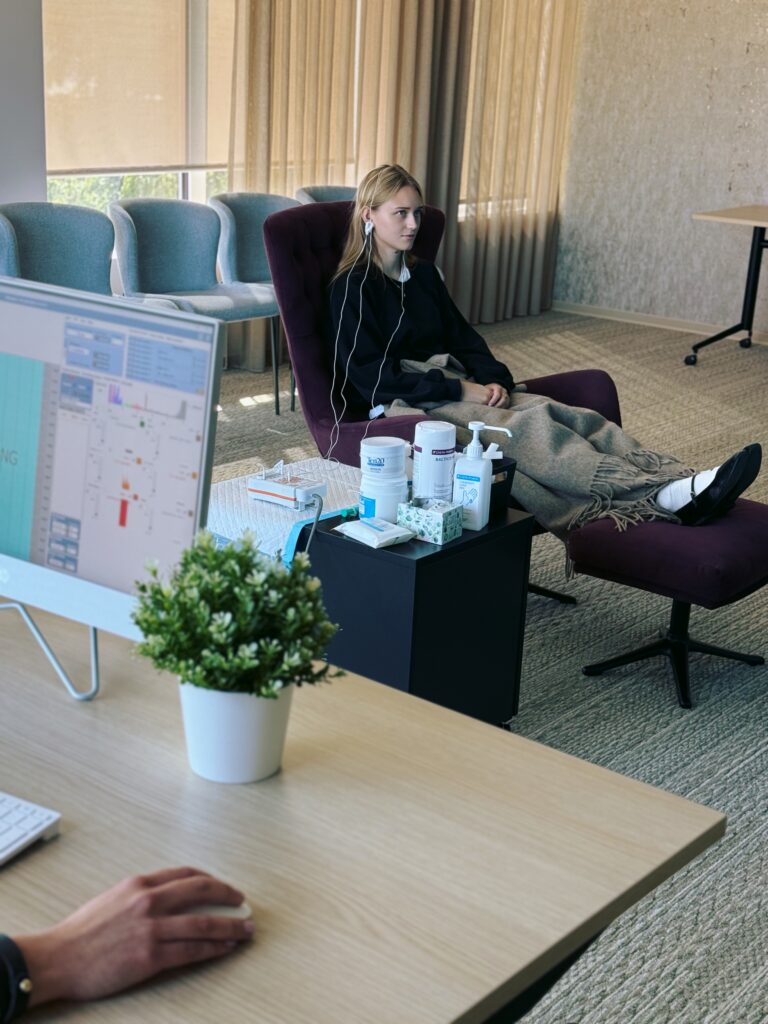
Neurofeedback, or EEG biofeedback, is a form of brain training in which the brain receives real-time feedback about its electrical activity.
- EEG sensors measure the brain’s electrical activity.
- A computer program analyses brain activity in real time.
- The brain receives feedback through video, images, or sound.
When the brain moves towards the target set in the personalised protocol, the video continues playing or a notification sound is heard. Through repeated feedback, the brain learns to regulate its activity more effectively.
EEG sensors only measure brain activity. They do not deliver electricity or magnetic pulses to the brain.
How many training sessions are needed?
Neurofeedback is a learning process that requires repetition and regular practice. Training sessions usually take place twice a week. The length of the programme is determined individually based on the qEEG assessment, symptoms, and goals. A programme often consists of 20–40 training sessions, although the required number may vary from person to person.
What does each step mean?
Appointment with a psychiatrist or mental health nurse
During the first appointment, we assess the symptoms, health status, everyday difficulties, and goals of the brain training. We evaluate whether neurofeedback could be a suitable method.
qEEG assessment
We measure the brain’s electrical activity and perform a quantitative analysis. The assessment is painless and non-invasive.
Feedback from the psychiatrist
The psychiatrist explains the qEEG assessment results and considers them together with the symptoms and everyday difficulties in functioning. Together, the goals of the brain training and the next steps are determined.
First brain training session
Based on the qEEG assessment and the psychiatrist’s evaluation, the mental health team develops a personalised neurofeedback protocol. We explain the entire process, the frequency of the training sessions, and how the results will be evaluated, and agree on independent exercises that support the outcome.
Regular brain training sessions
The training sessions take place under the guidance of a specialist. We monitor how the person feels and any changes in everyday functioning, and adjust the protocol and independent exercises if necessary.
Evaluation of results
We evaluate changes in attention, sleep, emotional well-being, energy levels, and everyday functioning. Based on the results, we decide whether to continue with the current protocol or adjust it.
Frequently asked questions
No. Neurofeedback is non-invasive and painless. EEG sensors only measure the brain’s electrical activity.
Sometimes, temporary fatigue, headache, restlessness, irritability, or changes in sleep may occur after a training session. Therefore, we monitor how the person feels and adjust the protocol if necessary.
Neurofeedback can be part of a comprehensive treatment or support plan. It does not replace treatment prescribed by a doctor, and medication must not be changed or discontinued without medical advice.
No. The person does not need to consciously control their brainwaves. The brain learns through feedback provided by video or sound.
Start your brain training journey
The neurofeedback programme begins with an appointment with a psychiatrist or a mental health nurse.
During the first appointment, we assess your needs and plan the next steps.
